


21st May 2026
The Southern Health and Social Care Trust is strengthening dementia care through simulation-based training that helps staff better understand the lived experience of people living with dementia.
As the number of people living with dementia continues to grow, supporting staff to better understand and respond to their needs is becoming increasingly important.
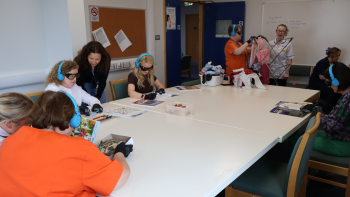
The training places healthcare staff in simulated scenarios designed to reflect the sensory, cognitive and physical challenges associated with dementia. Using equipment such as audio headsets with noise distortion, visual impairment glasses, restrictive gloves and shoe inserts, participants experience first-hand how everyday environments can quickly become difficult to navigate.
The focus is on building empathy, improving communication and enhancing care for people living with dementia, both in hospital and in the community.
The initiative is being highlighted as part of Dementia Action Week (18–24 May).
Peter Alexander, a service user living with dementia who observed the training, spoke about its impact:
“Seeing staff experience what it’s like for people like me living with dementia every day gives a completely different perspective. It helps people understand that simple things can be much harder than they appear, and how much the right support really matters.”
Consultant Dr Elaine Nelson, who helped design and deliver the programme, said the training is about developing greater understanding and compassion:
“Living with dementia can be frightening, frustrating and exhausting, not just for the person themselves, but also for their families and carers. This training gives our staff the chance to experience, even briefly, some of the challenges faced by people living with dementia.
“Participants wear equipment that affects their hearing, vision and movement, helping them better understand the impact dementia can have on communication, confidence and independence.
“Afterwards, during a debrief, we take time to reflect on how the simulation made participants feel and discuss how small changes can improve the care environment. This helps staff see how practical adjustments can make a real difference for people living with dementia.”
Evidence shows that simulation-based training can improve empathy, understanding and person-centred care — all of which are essential in supporting people living with dementia.
Debbie Burns, Director of Operations with the Trust, highlighted the growing importance of initiatives like this.
“Northern Ireland’s population is ageing rapidly, and we are already seeing this reflected in our services. The number of people living with dementia is expected to increase significantly in the years ahead.
“As demand grows, it is essential that we continue to invest in training that supports staff to deliver compassionate, person-centred care.
“Simulation-based training is a key part of how we are preparing our workforce to better understand people’s experiences, improve care, and support people to live well with dementia, in line with our Vision and Strategy 2030.”